
Will my body keep up with the life I want to live?
We measure how strong you are and compare it with what you want your body to keep doing. The answer is three things: where you stand, what is in the way, and what to work on before anything else.
Sometimes there is no gap. Then the answer is validation: you are where you need to be, and what to hold to stay there.
Then we set a date and measure again.
Your strength can change without you noticing.
Strength is not one thing. That is what surprises almost everyone we measure. It has parts, the parts decline at different rates, and you can be holding your own in one while losing ground in another. For years there is nothing to feel and nothing to see.
The curve starts in your forties. It does not hurt, and it does not show in the mirror. When a sign does come, it is usually first felt in speed. A step slower catching your kid, late getting to the ball, a jump you land heavier than you used to. Stairs come later, and then the downhill half of a hike.
After sixty the curve steepens, to about 3% a year by your seventies. How much strength you have at seventy is built, or lost, in the twenty years before.
All of it responds to training at any age. The earlier you can see the curve, the more room you have to work with.
Strength made measurable like the rest of your health.
Basal Strength was founded on one idea: strength is one of the best indicators we have of how we function and how we age, and yet it has been left to the gym. It is almost never measured with the rigor the rest of health gets.
A physical covers your heart, your blood, your body composition, sometimes your VO2. What your body can actually do, how much force it produces, how quickly, and how evenly across the two sides, is not on the panel. Whether you will still get down on the floor with a grandchild and back up unaided is not on it either, and it is answerable decades early.
We built an assessment that measures it. The instruments came out of elite sport, where professional athletes were measured this way and nobody else was. They have come down in cost and up in precision, and we have adapted the tests so someone who has never trained can be measured as reliably as an athlete: no maximal attempt required, the technique taken out of the number, and each test scaled to what you can safely do. That puts strength in the same conversation as your labs, a number with a source, tracked over time, read by your physician.
A baseline also holds its value when life interrupts. After an injury, an illness, or a stretch away from training, it is a measured place to work back to.
We measure strength as four separate things.
Force is two of the four: what your muscles can produce, and what you actually put into a movement.

Power
How fast you can produce force.How fast your body can deliver the force it has. An analogy: two phone cables carry the same charge, and the Lightning cable fills the phone in an hour while the one you bought at the airport takes all night. Power is the charging speed, and your strength is the charge. In life, the step that gets you to the ball and the hand that finds the rail when you trip. We measure it from a jump and a landing on the force plate.
Fastest to go · it's what catches you when you trip
Maximal force
The most force your muscles can produce.The most force a muscle group can produce in one position, with nothing moving. Steadying a ladder while someone climbs it, holding a door against the wind. A pull against a bar that does not give, each leg alone and then both.
Falls faster than mass
Expressed force
The force you can actually put into a movement.The force that arrives when several muscle groups work together and move. The suitcase into the overhead bin, the toddler up the stairs, the deadlift you are no longer sure you should attempt. We read it from bar speed under load, so nobody attempts a true maximum.
Usually goes before maximal force
Muscle mass
How much muscle you carry.How much muscle you carry, and the only one of the four you can see. The one in the mirror, and the first to go in a stretch of weight loss or a month off training. A DEXA scan, region by region, left against right.
Slowest to go · the only one you can see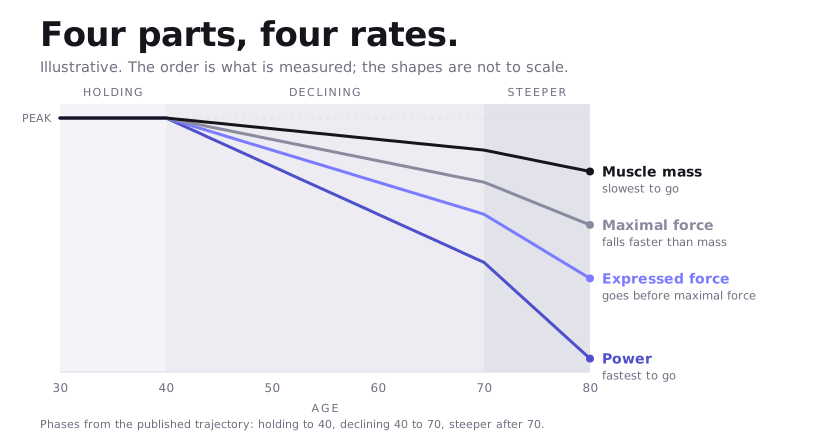
The limiters
Behind the strength numbers are key reasons that potentially limit those numbers. A restricted hip, a stiff ankle, a steadier right side than the left. They all provide an explanation for those numbers and often are the things that need addressing first.
Together, the four form the layer everything you love stands on. The level underneath, the one that has to be there before anything built on it holds. It is where the name comes from.
None of the four is a verdict. Two may be where they should be and two well short, one side years ahead of the other, and what any of it means depends on what you are trying to do with your body. The report says what to work on, and in what order, for the goals you came in with.
Different reasons. One question.
"I want to still be doing all of this at 70."
What we measure ·How fast you are losing strength, and how much of the loss is still yours to reverse.
"I keep getting hurt and I don't know why."
What we measure ·Which side, in which position, by how much.
"I stopped for a few years, or never really started. Either way, I want in."
What we measure ·Which part of your strength is furthest behind, because that is where the first twelve weeks go.
"I want to keep up with them now, and get off the floor on my own later."
What we measure ·Balance and control rather than force. Those track what you are actually worried about.
"I have a number in mind, and a date on it."
What we measure ·The gap between the force you can produce and the force that shows up in the lift.
"I need to know which limits to respect and which to attack."
What we measure ·Which limits are structural and which are trainable.
"I am losing weight. I do not want to lose strength with it."
What we measure ·Whether the strength that muscle produces is holding, which is a different measurement from how much muscle is left.
"I want to know how much is actually enough."
What we measure ·Sometimes the finding is that you are already there, and the report says so.
How strong do I need to be to do the things I love, and for how long?
That is the question this company was started on. The answer begins with a measurement. The assessment is the same for all eight. What changes is what the measurement is for.
Which side, in which position, by how much.
A finding is only useful if it is specific enough to act on. Three of them, anonymized.
She was landing harder on her weaker side
Thirty-eight, and a decade of injuries she suspected were connected: IT band pain, bursitis, a stress fracture. She had been through physical therapy more than once. Each round treated the one spot. On her left side she had less stability and less range, and she landed nineteen percent harder on it, hundreds of times a week.
Nothing wrong, and the leg carrying more was the one least able to absorb it
Forty-four, injury free, and he wants to still be running and lifting at seventy. His force production was above the age reference, which is the answer he expected. Tested alone, his right leg matched the left. Tested together, in the two-legged jumps and lifts, the right leg produced more of the force than the left, so it was doing more than half the work on every landing. It was also the stiffer leg at hip and ankle, and the less stable one to stand on. A 5K loads that leg about 2,500 times.
Ninety-second percentile, and thirty percent down in one position
She is in exceptional shape and the numbers said so. The assessment still characterized two problems she had been living with. One overhead position where her right side produced thirty percent less force. And a left hamstring that was always sore: the left leg tested weaker, and it was also the leg taking more of the load on every landing. Weaker and busier at once is a pattern that fits the soreness.
What none of these say is that the training will prevent the next injury. The pattern is real and the work is appropriate. The evidence for the leap from one to the other is thinner than the field usually admits, and the report says so.
Where we stop, and what happens after.
Do you diagnose or treat?
No. We measure and report. The findings are written for the people who do the treating and the training: your physician, your physical therapist, your trainer. When something in the data needs clinical eyes, the report says so, and says why.
Do you write my training program?
No, and the line is deliberate. The report gives the order of work: what to address first, what is bounded, what can wait. The programming comes from your trainer or physical therapist, built on the report.
What if I need someone to treat me, or to train me?
We keep a network of physicians, physical therapists and trainers in Austin we trust, who know how to read our reports, and we will introduce you. We accept no commission or referral fee for any introduction we make, and we do not pay for clients. We are paid for the assessment and nothing else.
Do I need a referral?
No. Most people book directly. If a physician or a physical therapist sent you, tell us who, and we will build their questions into the session.
What happens after the test?
We walk you through the report together and set a retest date, twelve to sixteen weeks out. At the retest we measure the areas you were working on and say whether the change clears the measure's margin of error.
What if a test is not safe for me?
We do not run it. A physical therapist is in the room for the whole session, every test is scaled to your ability, and the report names anything we skipped and why.
If there is something you love doing and you are not sure your body will keep letting you, I would like to talk.
fayazjaffer@basalstrength.com